Tunneled media and call degradation
WebRTC, which is used by the Pexip apps, is an innovative video technology that is portable and does not require the installation of specialized applications to provide video conference capabilities through the web browser and applications.
There are however some important points to be aware of for the best possible experience.
Like other real-time video technologies we recommend that you choose a suitable setting for bandwidth according to your internet connection capabilities; we also recommend that you use a wired network connection.
Beyond this, with WebRTC a common cause of degraded or poor video and audio quality is the utilization of TCP port tunneling. Call degradation may also include high latency causing shared content to take a long time to update.
Port restriction and forced tunneling is common in many web proxy environments.
With WebRTC, during the call setup the browser will attempt to send the media using UDP over an ephemeral port (=10,000). However if this port is administratively blocked for web users then the real time media (video and audio) will be forced to tunnel over TCP port 443.
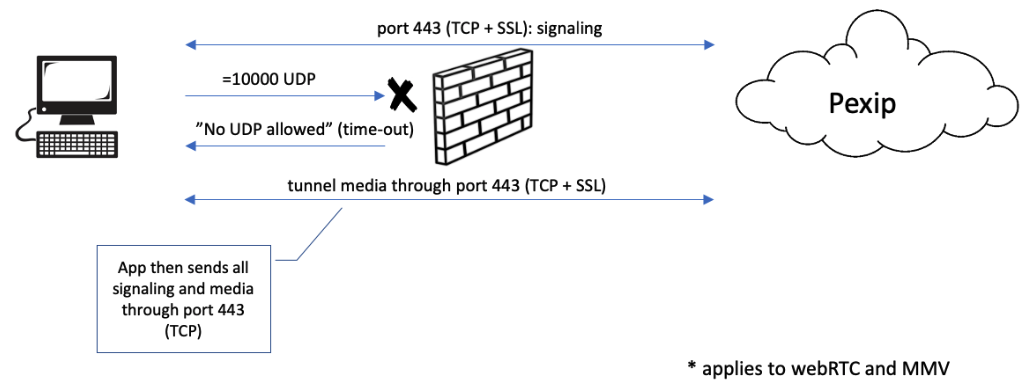
In the scenario where video is tunneled, there is a greater likelihood of packet loss, jitter and/or latency thus resulting in call degradation. The preferred method for transport of real time media is via UDP due to the transport efficiency and lower processing overheads.